
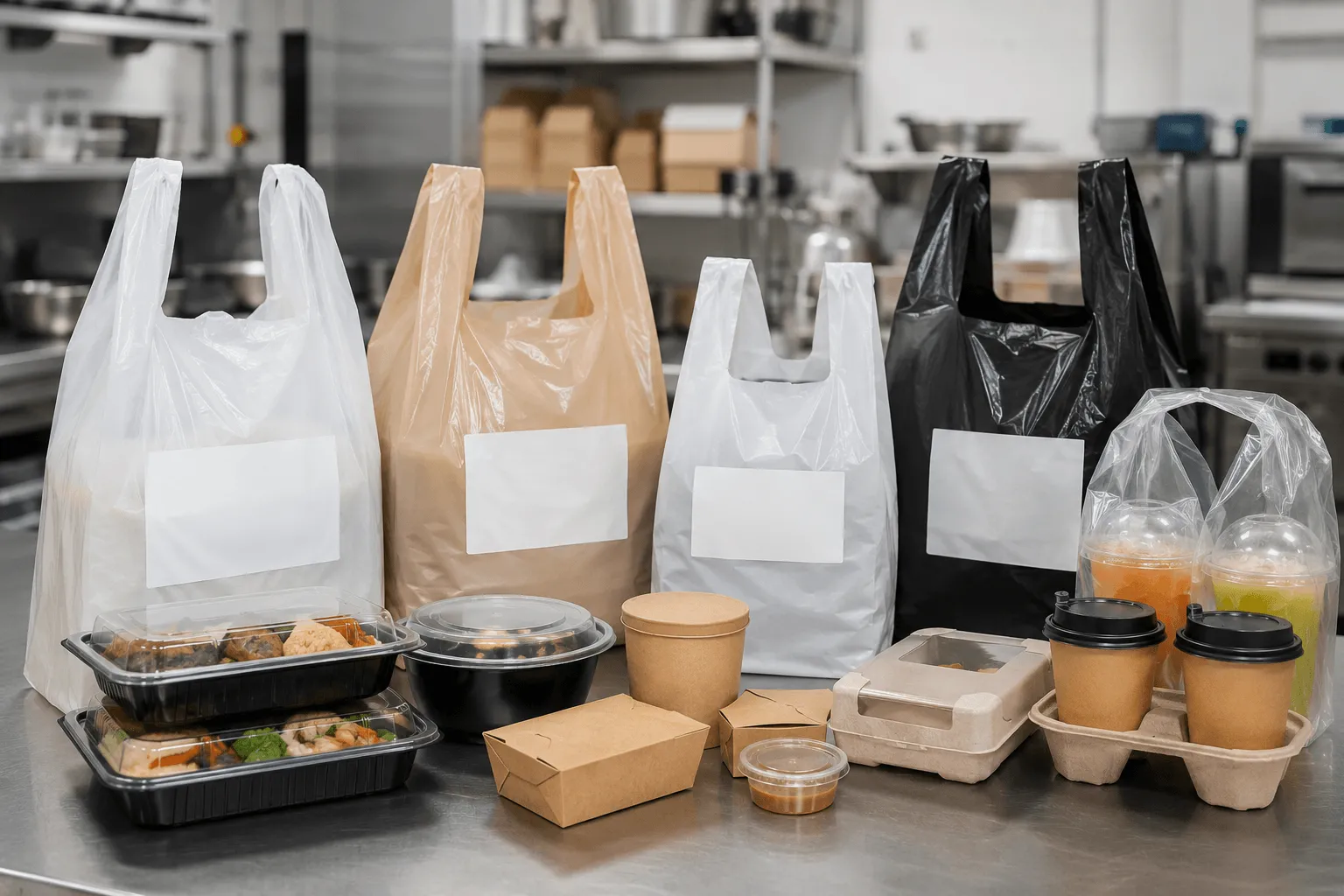
Can a plastic bag really make or break a cloud kitchen’s customer experience? For a food business with no dining room, no signage, and no face-to-face service, the packaging that arrives at the customer’s door is often the only physical touchpoint they’ll ever have with the brand — and in Malaysia’s fast-growing delivery economy, that detail matters more than most operators realise.
Malaysia’s food delivery and cloud kitchen sector has grown rapidly over the past few years, with more F&B brands operating entirely — or partially — without a physical storefront.
That shift has quietly changed what businesses need from their packaging supplier. It’s no longer enough to source “any plastic bag that fits.” Operators now need custom plastic bags for food delivery that hold up to grease, moisture, and transit time, while still representing their brand well when it lands on a customer’s doorstep.
Custom plastic bags for food delivery are food-grade carrier bags manufactured to a business’s specific size, thickness, material, and (optionally) printed design requirements, rather than bought off the shelf in generic sizes. For F&B and cloud kitchen use, “custom” usually covers three things:
This differentiates them from generic supermarket-style bags, which are rarely optimised for hot food, condensation, or the handling that comes with delivery rider transport.
Cloud kitchens and delivery-only F&B brands operate under conditions that traditional restaurants don’t face. Food sits in transit for anywhere from 15 to 45 minutes, often stacked with other orders, exposed to heat, condensation, and movement. A bag that isn’t fit for purpose can lead to:
For a cloud kitchen, there’s an added layer: packaging is often the only physical brand experience a customer has. Without a storefront to build trust through ambience or in-person service, the bag, its strength, its cleanliness, and its presentation quietly do that job instead.
“Food-safe” is a term used loosely, but it has a specific meaning: a food packaging bags supplier Malaysia businesses can trust should be able to demonstrate that its materials don’t transfer harmful substances, odours, or taste into the food they contain. This transfer is technically referred to as “migration,” and food-grade packaging is manufactured and tested to keep migration at levels that won’t affect food safety or quality.
In Malaysia, food packaging falls under the oversight of the Ministry of Health, governed by the Food Act 1983 and Food Regulations 1985, which set out requirements for materials that come into contact with food, along with labelling obligations. Reputable manufacturers also hold independent certifications — such as SIRIM marks or GMP (Good Manufacturing Practice) recognition — as evidence that their production process, not just the raw material, meets food-grade standards.
For F&B and cloud kitchen operators, this matters practically: a supplier that can show certified, food-grade production is one less compliance risk to manage, especially when scaling order volume across multiple delivery platforms.
Teong Chuan’s own production is backed by ISO 9001:2015 quality management certification and a GMP Codex Alimentarius certificate, alongside SIRIM Eco-Label recognition for eco-friendly product lines — the kind of documentation that F&B buyers should expect to see and verify before committing to a supplier.
Different order types call for different bag formats. Here’s a general comparison:
Singlet / T-shirt bag — Best for individual meal boxes, single-item orders, hawker-style takeaway. Key advantage: built-in handles, quick to pack, cost-efficient at high volume.
Flat / sealed bag — Best for wet items, soups, gravies, sauces. Key advantage: reduced leakage risk, tighter seal.
HDPE bag — Best for high-turnover, lightweight orders. Key advantage: strong-to-weight ratio, economical for bulk use.
LDPE bag — Best for heavier or oilier food, multi-container orders. Key advantage: softer, more puncture- and tear-resistant.
Biodegradable / Oxo-biodegradable bag — Best for brands prioritising sustainability positioning. Key advantage: breaks down faster under the right conditions, supports eco-conscious branding.
Most cloud kitchens don’t rely on a single bag type — many use singlet bags for standard takeaway and switch to a sturdier sealed or LDPE format for heavier or wetter orders, depending on the day’s menu.
Because cloud kitchens have no physical storefront, packaging quietly becomes one of their strongest marketing assets. Every delivery bag that reaches a customer’s door is effectively a mobile billboard — and one that shows up in unboxing photos, social media posts, and repeat-order decisions.
Custom printing on plastic bags can support this in several practical ways:
This is particularly relevant for cloud kitchens running more than one virtual brand from a single location, where distinct packaging helps separate one concept from another in the customer’s mind, even though both meals came from the same kitchen door.
Not every supplier offers the same level of consistency, compliance, or customisation. When evaluating a food packaging bags supplier Malaysia F&B businesses can rely on long-term, look for:
How much does custom plastic bag printing cost? Cost varies by bag size, material, print colours, and order quantity. Bulk orders typically bring per-unit cost down significantly, which is why most cloud kitchens work with a supplier directly rather than buying pre-printed stock in small batches.
What’s the minimum order quantity for custom printed bags? This depends on the supplier and print method, but private label plastic bag printing generally requires a minimum quantity to be cost-effective — worth confirming directly with your supplier before finalising a design.
Custom plastic bags for food delivery are no longer a minor operational detail — for cloud kitchens without a storefront, they double as the primary brand touchpoint, and for any F&B business, they’re a direct line to food safety and customer trust. Getting the material, size, and compliance right protects both your food and your reputation with every order that goes out the door.
As a plastic bag manufacturer in Malaysia with decades of production experience, Teong Chuan supplies custom T-shirt style delivery bags and private label plastic bag printing built for F&B and cloud kitchen use, backed by certified food-grade production and clear food-grade packaging symbols guidance for buyers who want to verify compliance before ordering.
Contact Us Now: to discuss sizing, material, and custom printing for your delivery packaging.