
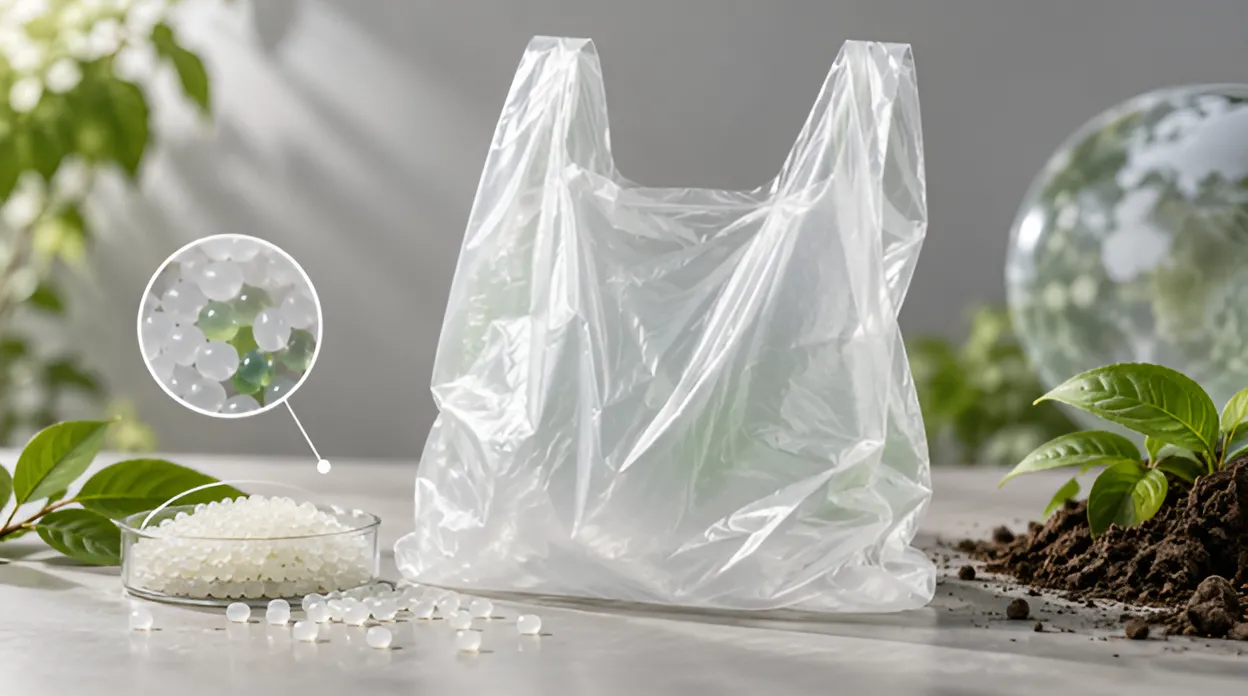
Global headlines have been unkind to oxo-biodegradable plastic. Reports out of the EU and UK describe it as “greenwashing” — a bag that simply fragments into invisible microplastics rather than actually disappearing. That criticism isn’t baseless. But it is incomplete, and it is largely built on European disposal conditions that don’t apply the same way in a country like Malaysia.
As a Malaysian plastic bag manufacturer working with oxo-biodegradable formulations daily, Teong Chuan sees where the criticism holds — and where it collapses once you account for climate, infrastructure, and correct usage.
This article breaks down what oxo-biodegradable plastic actually does, why the criticism exists, and why the calculation looks different for a tropical market like Malaysia.
Key Takeaways
Global headlines have been unkind to oxo-biodegradable plastic. Reports out of the EU and UK describe it as “greenwashing” — a bag that simply fragments into invisible microplastics rather than actually disappearing. That criticism isn’t baseless. But it is incomplete, and it is largely built on European disposal conditions that don’t apply the same way in a country like Malaysia.
As a Malaysian plastic bag manufacturer working with oxo-biodegradable formulations daily, Teong Chuan sees where the criticism holds — and where it collapses once you account for climate, infrastructure, and correct usage.
This article breaks down what oxo-biodegradable plastic actually does, why the criticism exists, and why the calculation looks different for a tropical market like Malaysia.
Oxo-biodegradable plastic is conventional plastic — usually HDPE or LDPE — manufactured with a small percentage of a pro-oxidant additive, typically a metal salt such as manganese or cobalt stearate. This additive accelerates oxidation when the plastic is exposed to heat, UV light, and oxygen, causing the long polymer chains to break into progressively shorter fragments. Once the molecular weight is low enough, naturally occurring microorganisms in soil can metabolize the remaining fragments as a carbon source, in much the same way they break down organic matter such as leaf litter.
This is different from compostable plastic, which is engineered to break down under the controlled heat and microbial density of an industrial composting facility, and different again from ordinary plastic, which simply persists indefinitely regardless of environment.
The core criticism is this: if oxidation stalls partway through the process, what’s left behind is small plastic fragments that behave like microplastics, with no guarantee that biodegradation ever completes. This happens under a specific set of conditions:
This is a legitimate failure mode, and it is the basis for the EU’s restriction under Directive 2019/904 (in force since July 2021) and Hong Kong’s outright ban introduced in 2024. It is not, however, a universal description of what happens in every climate or every disposal pathway — and treating it as one ignores where and how the plastic is actually being used.
Malaysia’s tropical climate — consistent high heat, an intense year-round UV index, and high humidity — sits close to the ideal condition set for oxidative degradation to run to completion rather than stall partway. Combined with open-air waste handling that remains common at the municipal level in many parts of the country, exposure to heat, oxygen, and UV is far less likely to be cut short than in a sealed landfill in a cooler climate.
Malaysia currently has no regulatory ban on oxo-biodegradable plastic. That doesn’t mean the technology is exempt from scrutiny — it means the calculus is genuinely different here, and manufacturers supplying this market should be transparent about the conditions the technology depends on, rather than importing a European verdict wholesale and applying it to a tropical context it wasn’t written for.
The entire pathway depends on steps three through five actually running to completion, which is precisely why environmental exposure matters just as much as the additive formulation itself — and why a bag engineered and tested for tropical exposure behaves differently in practice from one designed with a temperate climate in mind.
For most retail and household uses — carrier bags, garbage bags — the answer is yes. The additives used are the same class of metal-salt catalysts used elsewhere in food-contact-approved plastics, at very low concentrations well within accepted safety thresholds. The safety question that matters more in practice is disposal completeness, not the additive’s inherent toxicity. That is a manufacturing and end-of-life question, not a “the bag itself is harmful” question — and it’s why sourcing from a manufacturer that formulates specifically for tropical degradation conditions matters more than the label alone.
Conventional Plastic | Oxo-Biodegradable | Compostable | |
|---|---|---|---|
Breaks down without intervention? | No | Yes, with heat/UV/oxygen exposure | Only in an industrial composting facility |
Performs like standard plastic in use | Yes | Yes | Often more brittle and costlier |
Suited to Malaysia’s climate | N/A | Well-suited (high heat and UV) | Needs facility access, still rare locally |
Risk if disposal conditions are wrong | N/A (persists regardless) | Fragments without completing breakdown | Persists much like conventional plastic |
For retailers, F&B chains, and manufacturers choosing between conventional, oxo-biodegradable, and compostable packaging, the decision shouldn’t be based on a headline written about a different climate and a different waste infrastructure. Businesses operating in Malaysia are working within a context where oxo-biodegradable technology has a genuine, evidence-backed pathway to full degradation — provided the material is formulated correctly and disposed of in typical local conditions.
Teong Chuan’s singlet and T-shirt bags and private-label packaging lines are manufactured with this local context in mind, rather than adapted from a European specification sheet.
It can, if oxidation is interrupted before fragments reach a low enough molecular weight for microbial digestion — typically due to insufficient heat, UV, or oxygen exposure. In consistently hot, sun-exposed conditions like Malaysia’s, the process is considerably more likely to run to completion.
No. Malaysia has no current ban on oxo-biodegradable plastic, unlike the EU and Hong Kong. Regulations can change over time, so businesses sourcing packaging should stay informed and work with manufacturers who track these developments.
No. Compostable plastic requires an industrial composting facility with controlled heat and microbial activity to break down. Oxo-biodegradable plastic degrades through ambient heat, UV, and oxygen exposure, without needing dedicated facility access.
Compostable infrastructure is still limited in Malaysia, and compostable bags typically cost more and perform less durably in everyday use. Oxo-biodegradable bags offer a practical middle ground suited to local climate conditions and current waste infrastructure.
Ask the manufacturer directly about the additive concentration and the conditions it was tested under. A manufacturer based in and formulating for the local market — rather than reselling a specification designed for a temperate climate — is generally better positioned to confirm this.
Oxo-biodegradable plastic isn’t the villain that European headlines make it out to be, nor is it a flawless solution. It’s a technology whose outcome depends heavily on climate and disposal conditions, and those conditions are far more favourable in Malaysia than in the markets driving the criticism.
Teong Chuan’s oxo-biodegradable plastic bags are formulated specifically for tropical degradation conditions, manufactured under ISO 9001:2015 and SEDEX-compliant standards, and backed by Teong Chuan’s ongoing sustainability commitments. Businesses evaluating packaging options can also compare against Teong Chuan’s LDPE bag range to weigh durability, cost, and end-of-life profile side by side.