
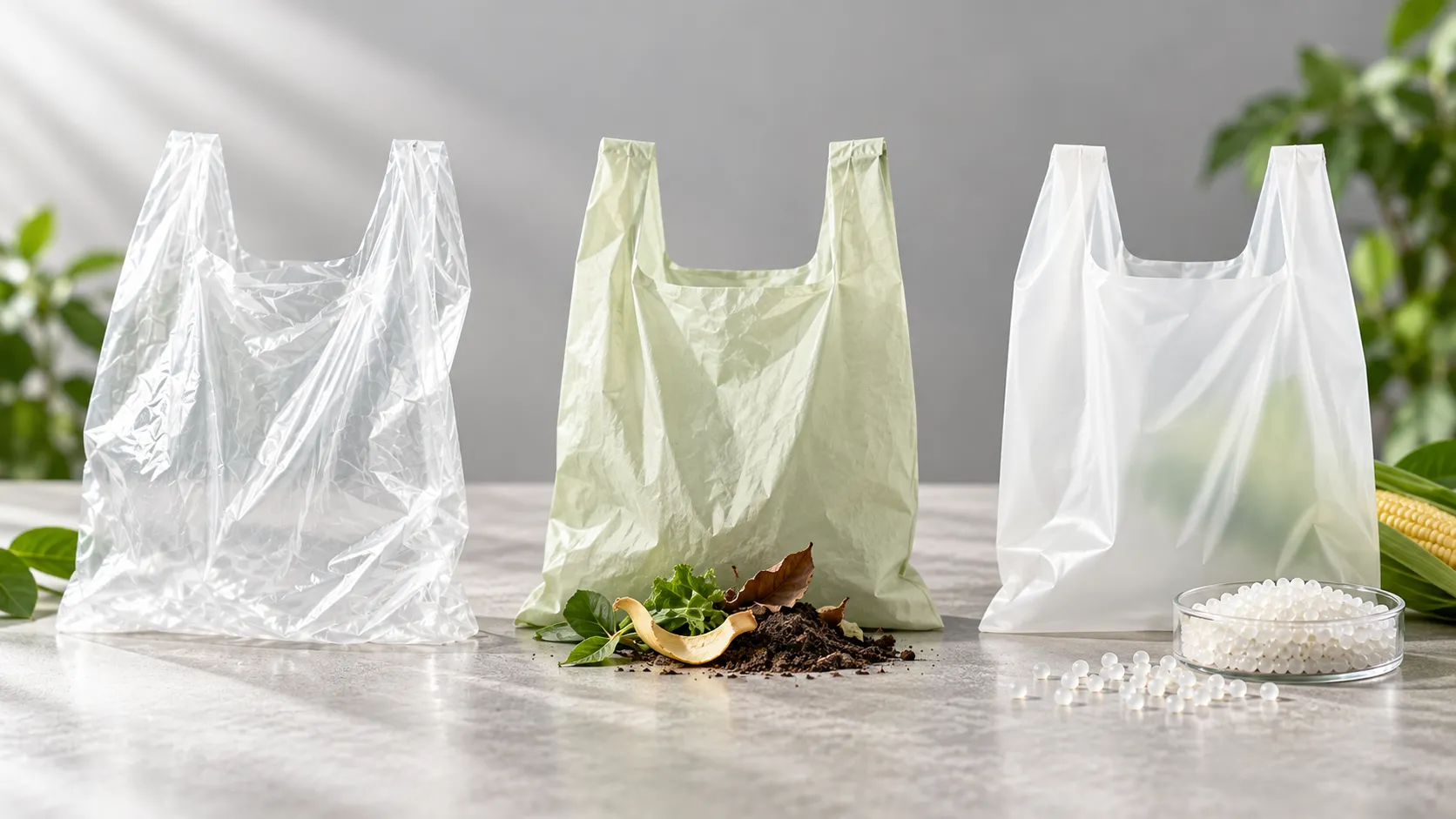
Choosing between oxo-biodegradable, compostable and bioplastic bags is not simply a question of which material sounds more environmentally friendly.
For Malaysian businesses, the more useful question is:
What will actually happen to the bag after the customer throws it away?
Each material is designed around different degradation conditions and waste-management pathways. If the required disposal route is unavailable, a material may not perform in the way its label suggests.
This matters particularly in Malaysia, where recycling and organic-waste treatment infrastructure continues to develop, but access to dedicated industrial composting for packaging is not yet something most businesses or consumers can assume.
Oxo-biodegradable plastic is generally conventional polyethylene containing an additive intended to accelerate oxidation when exposed to environmental triggers such as heat, oxygen and UV light.
Compostable plastic is designed to biodegrade under specified composting conditions. Industrially compostable and home-compostable products should not be treated as the same thing.
Bioplastic is a broad category. A bioplastic may be bio-based, biodegradable, both, or neither in the way consumers commonly assume.
Industrially compostable packaging needs an appropriate collection and composting route to deliver its intended end-of-life benefit.
Malaysian businesses should evaluate packaging based on the actual disposal pathway, not simply terms such as “natural”, “green” or “plant-based”.
Environmental claims should be supported by relevant testing, certification and clearly stated degradation conditions.
Many international packaging comparisons assume that customers can place certified compostable products into a dedicated organic-waste stream that is collected and transported to an industrial composting facility.
That assumption does not necessarily apply in Malaysia.
Malaysia has been expanding recycling, source separation and organic-waste initiatives, but there is still no broadly accessible nationwide industrial composting network handling compostable packaging from normal municipal waste.
Some local authorities and private operators are developing food-waste composting programmes, but this does not mean a compostable shopping bag or bin liner placed in a normal waste bin will automatically reach an appropriate composting facility.
As a result, businesses should look beyond the packaging label and ask where the product is realistically likely to end up.
Oxo-biodegradable plastic generally starts with a conventional polymer such as HDPE or LDPE, combined with an additive intended to accelerate oxidation.
Exposure to factors such as heat, UV light and oxygen can initiate changes in the polymer structure and reduce its molecular weight over time.
This is different from certified compostability.
The exact degradation behaviour depends on the formulation, surrounding environment and test method. Claims about a specific degradation timeframe therefore need to be supported by evidence for the actual product rather than applied universally to every oxo-biodegradable bag.
Businesses considering this material can review Teong Chuan’s oxo-biodegradable plastic bag options and request the relevant technical information for the formulation being supplied.
Compostable plastic is designed to biodegrade under defined composting conditions within a specified timeframe.
However, there are two important categories.
Industrially compostable products require controlled conditions such as appropriate temperature, moisture, aeration and microbial activity. Standards such as EN 13432 and ASTM D6400 are commonly used to assess industrial compostability.
Home-compostable products are designed for lower-temperature composting conditions and require different testing or certification.
A product certified for industrial composting should therefore not automatically be described as suitable for home composting.
This term causes some of the most confusion.
A bioplastic is not necessarily compostable, and it is not necessarily made entirely from plants.
Bioplastics are a broad family of materials that may be:
Bio-based
Biodegradable
Both bio-based and biodegradable
For example, PLA is produced from renewable feedstocks and is commonly used in food-service packaging, but many PLA products require industrial composting conditions to biodegrade as intended.
Other bio-based plastics may behave more like conventional plastics at end of life.
This is why the term “bioplastic” alone tells you very little about how a bag should actually be disposed of.
| Factor | Oxo-Biodegradable | Compostable | Bioplastic |
|---|---|---|---|
| What it describes | Plastic incorporating degradation-promoting technology | End-of-life behaviour under specified composting conditions | A broad family of bio-based and/or biodegradable plastics |
| Typical base | Often PE such as HDPE or LDPE | Varies by formulation | PLA, PHA, bio-PE and many others |
| Main degradation conditions | Depends on formulation; commonly exposure to heat, oxygen and UV | Controlled composting conditions according to certification | Depends entirely on the polymer |
| Industrial facility required? | Not generally defined as an industrial-composting product | Yes for industrially compostable products; not necessarily for certified home-compostable products | Depends on material |
| Can it go into normal plastic recycling? | Depends on product and local recycler requirements | Generally should not be mixed into conventional PE/PP recycling | Depends on polymer |
| What businesses should verify | Test method, degradation conditions and evidence supporting claims | Certification, industrial vs home composting and accepted waste stream | Exact polymer, bio-based content and end-of-life instructions |
The key point is that these terms describe different characteristics.
They should not be treated as three interchangeable versions of the same “eco-friendly plastic”.
An industrially compostable bag performs as intended when it reaches the controlled composting conditions specified by its certification.
If it instead enters normal mixed waste and is buried in landfill, those conditions may not exist.
Landfills can have very different temperatures, moisture levels and oxygen availability from an industrial composting facility. As a result, the degradation timeframe stated under composting standards should not be assumed to apply in landfill.
For Malaysian businesses, this creates an important practical question:
Can you realistically direct the used packaging into an appropriate composting stream?
If your organisation has a dedicated organic-waste programme or works with a waste contractor that accepts certified compostable packaging, industrially compostable material may be a logical option.
If not, the environmental benefit expected from industrial compostability becomes harder to realise.
Home-compostable products need to be distinguished from industrially compostable ones.
A properly certified home-compostable bag is designed to biodegrade under lower-temperature composting conditions than products requiring industrial facilities.
That can make it relevant where the end user actually maintains a composting system.
However, putting a home-compostable bag into a normal rubbish bin is still not the same as composting it.
Businesses should therefore avoid assuming that “home compostable” means “will disappear anywhere”.
Look for recognised certification and clear disposal instructions rather than relying on the word compostable alone.
Malaysia’s warm climate provides some of the environmental factors associated with oxidation, particularly heat and strong sunlight where plastic is exposed outdoors.
However, climate alone does not guarantee a specific degradation outcome.
A bag buried deep in landfill, stored indoors or otherwise shielded from light and oxygen experiences very different conditions from a bag exposed to the open environment.
For that reason, businesses evaluating oxo-biodegradable bags should request information on:
The specific additive or technology used
Testing standards or laboratory results
Conditions under which degradation claims were measured
Expected timeframe under those conditions
What happens after the initial oxidation stage
Compatibility with the intended waste or recycling route
This is more useful than relying on a generic statement such as “breaks down in 12 months”.
One of the most common assumptions about bioplastics is that a plant-based material will naturally disappear after disposal.
That is not necessarily the case.
Feedstock and end-of-life behaviour are separate characteristics.
A polymer can be derived partly or entirely from renewable biomass but still require specialised conditions for degradation. Conversely, some biodegradable polymers can contain fossil-based components.
When evaluating bioplastic bags, businesses should therefore ask two separate questions:
What is the material made from?
What needs to happen to it after use?
Both matter.
Start with the waste route.
Will customers return the packaging?
Will it enter conventional recycling?
Will it be collected with organic waste?
Will it enter mixed municipal waste?
A material that depends on a disposal system your customers cannot access may not deliver the outcome you expect.
Terms such as biodegradable and compostable should be supported by specific conditions and recognised testing.
Ask the supplier what standard applies and what the certification actually covers.
Do not treat these terms interchangeably.
If the bag is industrially compostable, check whether an appropriate composting route is available.
If it is home compostable, check the certification and expected conditions.
Environmental considerations need to be balanced against practical packaging requirements such as:
Load strength
Moisture resistance
Heat resistance
Flexibility
Shelf life
Printing requirements
Food-contact requirements where applicable
A material that works well environmentally but fails during storage or transport may create additional waste rather than reduce it.
Avoid making broad claims such as:
“100% environmentally friendly”
“disappears naturally”
“breaks down anywhere”
“plastic-free”
unless the product evidence genuinely supports them.
More specific statements about material composition, certification and disposal conditions are more useful to customers and easier to substantiate.
No. Compostability describes degradation under specified composting conditions.
No. Bioplastic is a broader category covering materials that may be bio-based, biodegradable, or both.
No. They rely on different degradation mechanisms and should not be placed in the same category.
No. Temperature is only one factor. Light, oxygen, moisture, microbial activity, material formulation and disposal conditions all influence degradation.
Not necessarily. The environmental outcome depends partly on whether the material’s intended end-of-life pathway actually exists and is used.
There is no single material that is automatically the best choice for every Malaysian business.
The better approach is to match the packaging to its real end-of-life pathway.
Industrially compostable packaging makes the most sense where a business can reliably collect it and send it to an appropriate composting facility.
Home-compostable packaging may be relevant when customers genuinely have access to suitable composting conditions.
Bioplastics need to be evaluated individually because the term itself does not tell you whether the product is recyclable, compostable or biodegradable in a particular environment.
Oxo-biodegradable packaging should be evaluated according to the specific technology, evidence supporting its degradation claims and the conditions in which the product is expected to be discarded.
For many businesses, the first question therefore should not be:
“Which material sounds the greenest?”
It should be:
“Where will this packaging actually go after use?”
No. Oxo-biodegradable plastic generally uses additives intended to accelerate oxidation of conventional plastic, while compostable plastic is designed to biodegrade under specified composting conditions.
They should not be assumed to do so within the timeframe stated by industrial compostability standards. Landfill conditions differ significantly from controlled composting environments.
No. Bioplastics are a broad family of materials that can be bio-based, biodegradable, or both. The exact polymer and formulation should be checked.
No. Being derived from renewable feedstock does not automatically make a plastic compostable.
Generally, compostable plastics should not simply be mixed with conventional PE or PP recycling unless the local recycling operator specifically accepts them.
Ask for the exact material composition, relevant test standards or certifications, required degradation conditions, expected timeframe, disposal instructions and any limitations on recycling or composting.
Sustainable packaging decisions become much clearer once the conversation moves beyond labels.
Oxo-biodegradable, compostable and bioplastic bags are built around different material technologies and end-of-life assumptions. None should be evaluated purely on whether its name sounds more environmentally friendly.
For Malaysian businesses, the practical starting point is understanding where the packaging will actually go after use, then selecting a material whose performance and disposal requirements match that pathway.
Teong Chuan manufactures packaging across different material categories for retail, household and private-label applications.
To discuss which material suits your product, performance requirements and intended disposal pathway, contact Teong Chuan for product specifications and available options.