
D2w-enabled bags engineered to break down faster than conventional plastic — manufactured in Port Klang since 1977.
Teong Chuan Plastic (M) Sdn Bhd manufactures oxo-biodegradable plastic bags from our 5-acre production facility in Port Klang, Selangor. Our oxo-biodegradable range uses D2w pro-degradant additive technology to accelerate the breakdown of conventional polyethylene, giving businesses a packaging option engineered to fragment and degrade faster than ordinary plastic once it enters the open environment.
This page explains what oxo-biodegradable plastic actually is, how it differs from compostable material, and what Teong Chuan’s oxo-biodegradable bags are built to do — so you can specify the right material for your application with confidence.
Oxo-biodegradable plastic is conventional polyethylene (the same base material used in standard HDPE and LDPE bags) blended with a small amount of pro-degradant additive during extrusion. The additive — commonly a transition-metal salt catalyst such as D2w — does not change the bag’s handling, strength or manufacturing process. During normal use and storage, an oxo-biodegradable bag behaves exactly like a standard plastic bag.
The difference appears at end of life. When the bag is exposed to UV light, heat and oxygen in the open environment, the additive accelerates oxidation of the polymer chain. This is a genuinely distinct mechanism from compostable plastics, which are made from plant-based polymers and break down through a biological composting process rather than an additive-driven chemical one.
Degradation happens in two stages:
Because the first stage does not require moisture or a composting facility, oxo-biodegradable plastic is designed to start breaking down in ordinary outdoor conditions — a landfill surface, roadside litter, or open storage — rather than needing to be routed to an industrial composting plant.
| Conventional Plastic | Oxo-Biodegradable | Compostable |
Base material | Polyethylene (PE) | PE + pro-degradant additive | Plant-based polymer (e.g. PLA, PBAT) |
Breakdown trigger | None — persists for centuries | UV light, heat, oxygen | Microbial activity under composting conditions |
Facility required | N/A | No — degrades in the open environment | Yes — industrial or home composting |
Typical breakdown time | Up to 1,000 years | 12 – 18 months (open environment) | Weeks to months (under composting conditions) |
Recycling compatibility | Compatible with PE recycling streams | Compatible with PE recycling streams before degradation begins | Not compatible — contaminates PE/PP/PET recycling streams |
Oxo-biodegradable material is available across our core bag formats, manufactured to your size, thickness and print specification:
retail carrier bags for supermarkets, pharmacies and F&B outlets.
for household, commercial and municipal waste collection.
for general packing, food service and industrial use.
oxo-biodegradable material can be applied to any of the above under your own branding.
All oxo-biodegradable bag products can be custom-manufactured in the size, gauge and print finish your business requires.
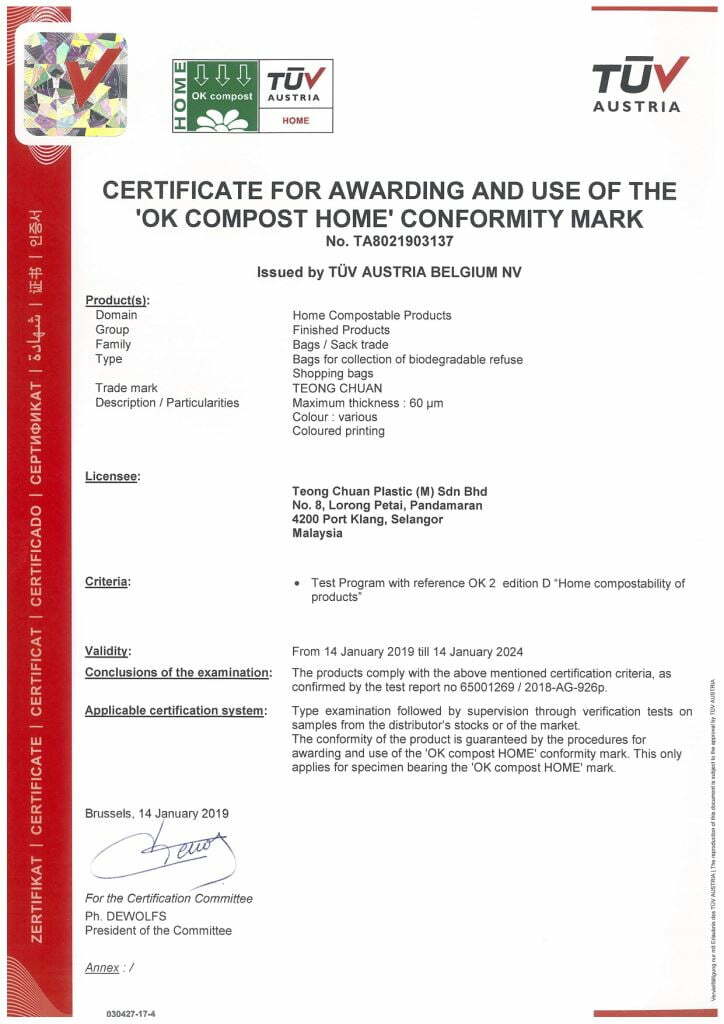
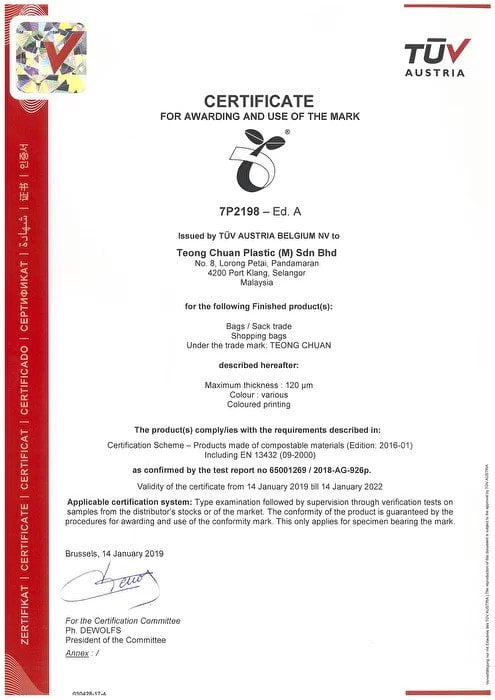
Teong Chuan Plastic is certified to ISO 9001:2015 and SEDEX standards, ensuring high-quality manufacturing and ethical business practices. Our eco-friendly packaging solutions are backed by recognized sustainability certifications, including TÜV AUSTRIA OK Compost HOME and OK Compost INDUSTRIAL, AS 5810 Home Composting certification by the Australasian Bioplastics Association, Global Recycled Standard (GRS), SIRIM Eco-Label, and Malaysia’s MyHIJAU Mark.
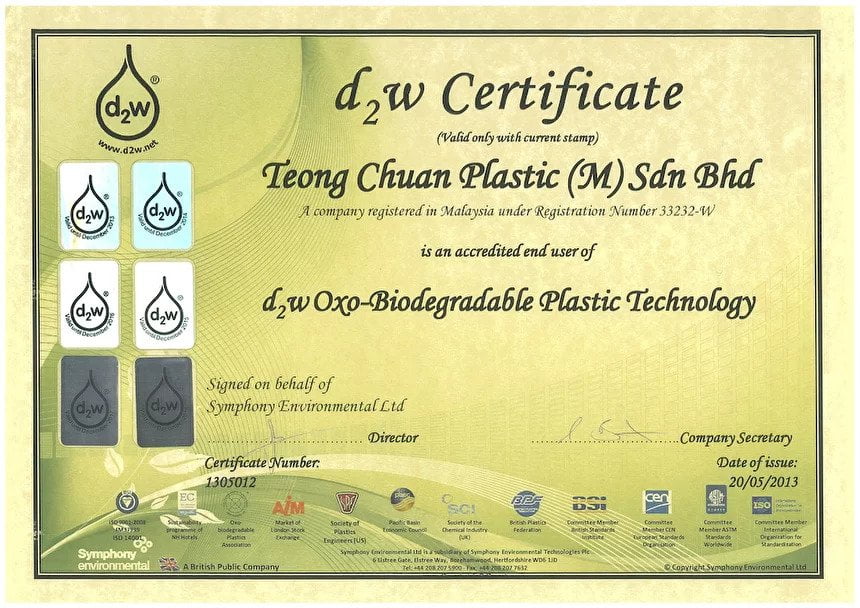
Our oxo-biodegradable materials utilize D2w controlled-life additive technology, reinforcing our commitment to environmentally responsible plastic packaging solutions.



Oxo-biodegradable plastic is not a universal replacement for every packaging need, and quality varies between manufacturers depending on the additive technology used. A well-specified oxo-biodegradable bag — using a controlled-life additive with a defined degradation timeframe — offers a genuine advantage over conventional plastic in applications where bags are likely to end up as open-environment litter, such as agricultural, coastal or general retail use. It is not a substitute for certified compostable material in food-waste or industrial composting applications.
Malaysia’s plastics policy is actively moving toward certified compostable and biodegradable materials under the SIRIM ECO 001/009 framework as part of the national Zero Single-Use Plastics 2018–2030 Roadmap. Businesses specifying oxo-biodegradable packaging for a regulated use case should confirm current local requirements before ordering, as standards continue to evolve state by state.
Oxo-biodegradable plastic is conventional polyethylene blended with a pro-degradant additive. The additive accelerates oxidation when the plastic is exposed to UV light, heat and oxygen, breaking the polymer chain into smaller fragments that can then be consumed by naturally occurring microorganisms.
Teong Chuan’s oxo-biodegradable bags are engineered to fully break down in 12 to 18 months in the open environment, compared to up to 1,000 years for conventional plastic. Actual timing depends on UV exposure, heat and oxygen availability at the disposal site.
No. Oxo-biodegradable bags fragment through an additive-driven oxidation process and are designed to degrade in the open environment without a special facility. Compostable bags are made from plant-based polymers and require industrial or home composting conditions to break down fully into biomass. The two materials are not interchangeable and should not be disposed of the same way.
Because oxo-biodegradable bags are made from conventional PE with a pro-degradant additive rather than a different base polymer, they are generally compatible with standard PE recycling streams, provided they are collected and recycled before significant degradation has begun.
Oxo-biodegradable bags are currently permitted for sale and use in Malaysia. Buyers should note that Malaysia’s plastics policy is shifting toward certified compostable and biodegradable materials under the SIRIM ECO 001/009 framework, and should confirm current certification status directly with the manufacturer before specifying oxo-biodegradable material for a regulated use case.
Teong Chuan manufactures oxo-biodegradable singlet/t-shirt bags, garbage bags and flat bags, and can produce custom private label oxo-biodegradable packaging to a buyer’s size, thickness and print specification.