
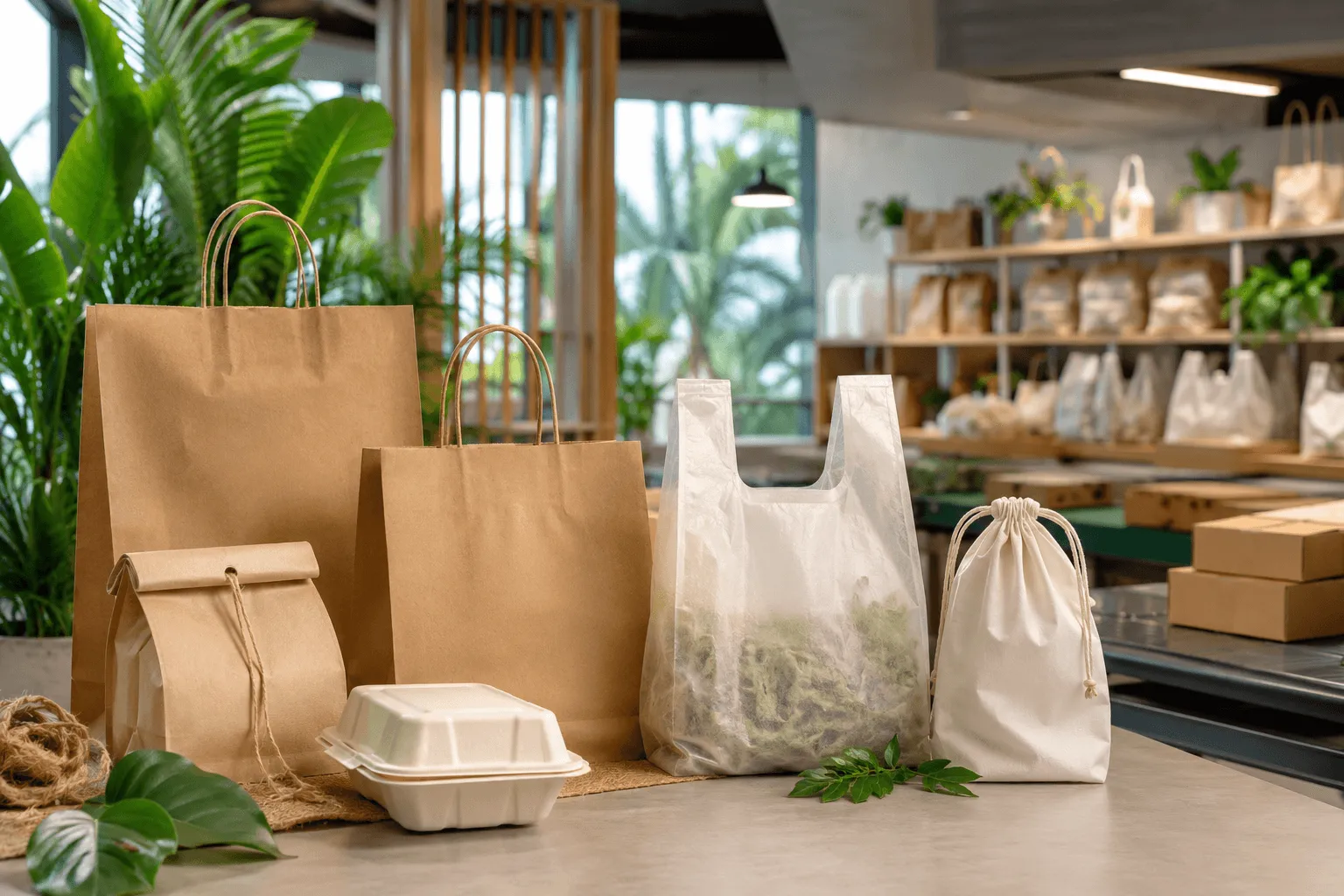
Why are traders at wet markets, retailers, and even cloud kitchens across Malaysia switching to biodegradable bags — despite them costing more than conventional plastic? The answer isn’t just regulation. It’s a shift in what customers expect to see at the checkout counter and the stall front.
Key Takeaways
Malaysia’s plastic packaging landscape has been shifting for several years, but the pace has picked up recently. What used to be a niche, cost-driven decision for a handful of eco-conscious retailers is increasingly becoming a mainstream expectation — from national sustainability roadmaps down to the plastic bag handed over at a neighbourhood wet market stall.
The push toward biodegradable bags in Malaysia isn’t coming from a single direction — it’s converging from policy, retail, and consumer behaviour at the same time.
On the policy side, Malaysia has worked toward reducing single-use plastics as part of a national sustainable development roadmap, with government officials publicly encouraging small traders and stall operators to move toward biodegradable alternatives. Cost remains a real factor in that transition — conventional plastic is still generally cheaper to produce than biodegradable plastic, which is part of why adoption has been gradual rather than immediate.
At the same time, retailers and F&B brands are responding to a customer base that increasingly associates biodegradable packaging with a more responsible, forward-thinking business — a perception that can influence repeat custom, even when the packaging itself isn’t the product being sold.
The shift isn’t only happening in policy papers — it’s visible on the ground. In Seremban, for example, local reporting has noted that nearly all traders at the Seremban Central Market have switched to using biodegradable plastic bags, according to a state executive councillor. That’s a meaningful signal: wet markets are typically the most cost-sensitive, highest-volume users of plastic bags in the country, so their adoption suggests the switch is becoming practical, not just symbolic.
This mirrors a broader pattern across hawker stalls, wet markets, and small retailers — sectors that were traditionally the slowest to change packaging habits due to tight margins, now increasingly stocking biodegradable bags as their default option.
Consumer attitude research offers some insight into why this shift is sticking rather than fading. Industry-cited survey data suggests that a majority of Malaysians say they prefer eco-friendly packaging over conventional plastic, largely due to concerns about plastic pollution. A notable share of consumers also indicate they’re willing to pay a premium for products packaged in biodegradable materials — suggesting that, for many shoppers, sustainable packaging is no longer treated as an unnecessary added cost, but as a value-add.
This preference tends to be strongest among younger, urban consumers, but awareness campaigns and clearer labelling are gradually extending that expectation into broader retail and food service settings.
Rising demand has also exposed a real problem: not everything labelled “biodegradable” behaves the same way, and the confusion is widespread even among businesses trying to do the right thing.
Reporting on Malaysia’s compostable packaging sector has highlighted that oxo-degradable and photo-degradable plastics don’t compost in the way many buyers assume — they break down into smaller fragments rather than fully biodegrading, and a 2016 European Commission report found this type of plastic isn’t suitable for composting and can affect the quality of recycled plastic. True compostable plastics, by contrast, typically require specific conditions — such as sustained heat in an industrial composting facility — to break down fully within a matter of months, conditions that aren’t always available through standard household or municipal waste systems in Malaysia.
This is exactly why certification matters more than the word “biodegradable” printed on a bag. Locally, SIRIM Eco-Label and SIRIM ECO 001 recognise verified biodegradable and compostable plastics, while international marks like TUV Austria OK Compost confirm a product has been independently tested against a recognised composting standard. For a deeper explanation of how these material types actually differ, see our breakdown of biodegradable, compostable, and oxo-degradable plastics.
For businesses reacting to this demand shift, a few practical realities are worth factoring in:
Readers who want a fuller comparison of the specific alternatives available — paper, cotton, PP, and oxo-biodegradable bags among them — can refer to our earlier guide on sustainable and biodegradable bag alternatives for Malaysian businesses.
With demand rising, so has the number of suppliers making sustainability claims. Before committing to a supplier, it’s worth checking for:
Generally, yes — biodegradable plastic currently costs more to produce than conventional plastic, though the price difference varies by material type and order volume, and has been narrowing as demand increases.
No. Many biodegradable and compostable plastics require specific conditions — such as industrial composting heat — to break down fully. A bag can be genuinely biodegradable under certification and still take a long time to decompose in a standard landfill.
The rise in demand for biodegradable bags in Malaysia reflects a shift that’s now visible at every level — from national policy down to the local wet market stall. But as demand grows, so does the importance of sourcing verified, properly certified biodegradable plastic rather than relying on packaging claims alone.
As a plastic bag manufacturer in Malaysia producing certified Oxo-biodegradable and compostable bags backed by SIRIM Eco-Label and TUV Austria recognition, Teong Chuan supplies custom and private label biodegradable bags for businesses navigating this shift.
Contact Us Now to discuss biodegradable material options and certification documentation for your business.
Read More: Make informed packaging decisions. Read our guide to the most common biodegradable plastic bag myths in Malaysia.