
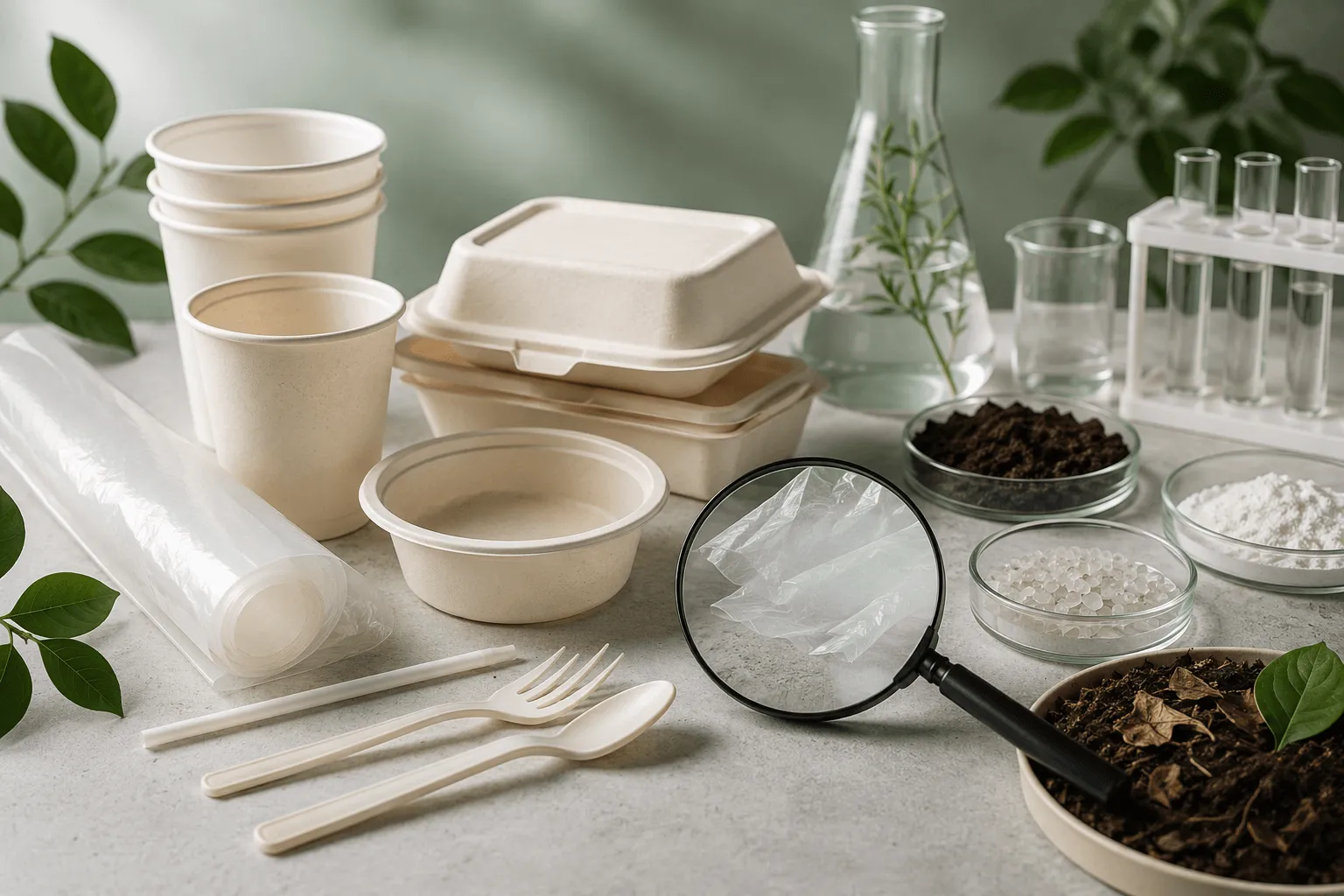
Walk into any supermarket or food court in Malaysia today and you will likely see packaging proudly labelled ‘biodegradable.’ It sounds straightforward — buy this product, use it, throw it away, and the planet takes care of the rest. If only it were that simple.
The reality of biodegradable plastic is considerably more nuanced than the marketing suggests. A wave of well-intentioned but inaccurate claims has surrounded biodegradable packaging for years, creating genuine confusion among retailers, consumers, and procurement teams alike.
In Malaysia, where government policy under the Zero Single-Use Plastics 2018–2030 Roadmap is actively reshaping packaging standards, separating fact from myth is no longer just an environmental exercise — it is a business and compliance necessity.
This article addresses the most persistent myths about biodegradable plastic bags and biodegradable packaging, and replaces them with accurate, verifiable information.
Key Takeaways
Biodegradable plastic refers to plastic materials designed to break down through biological processes under suitable environmental conditions. However, products sold as biodegradable in Malaysia can use very different materials and technologies, including compostable bioplastics and additive-based oxo-biodegradable plastics.
For Malaysian businesses, the important question is not simply whether packaging is labelled “biodegradable”, but what conditions are required for degradation, what certification supports the claim and whether the available waste-management pathway is suitable for that material.
| Type | How it works | Important consideration |
|---|---|---|
| Compostable plastic | Breaks down under defined composting conditions | Check certification and disposal infrastructure |
| Oxo-biodegradable | Additives accelerate oxidation of conventional plastic | Different from compostable plastic |
| Biobased plastic | Made partly or fully from renewable feedstock | Not automatically biodegradable |
| Conventional recyclable plastic | Designed for conventional recycling streams | Correct separation is essential |
The confusion around biodegradable plastic is partly the result of inconsistent industry terminology, partly greenwashing by manufacturers who apply the ‘biodegradable’ label loosely, and partly a genuine information gap among buyers and consumers who want to do the right thing but do not have the technical background to evaluate claims independently.
In Malaysia, this confusion is compounded by the speed of regulatory change. As the government moves to phase out single-use plastics and retailers face pressure from both policy and consumer expectation, procurement teams are making packaging decisions quickly — sometimes without fully understanding what they are buying.
The Reality
Biodegradable materials require specific environmental conditions to degrade effectively. The word ‘biodegradable’ simply means the material is capable of being broken down by biological organisms — bacteria, fungi, and other microbes. It says nothing about how fast that breakdown will occur, or under what conditions.
Many conventional biodegradable plastics require elevated temperatures, specific moisture levels, and active microbial communities to decompose within a reasonable timeframe. In a standard Malaysian landfill — compacted, often low in oxygen, and not managed for composting conditions — the same bag labelled ‘biodegradable’ at point of sale may persist for years without meaningful degradation.
Some bioplastic materials (such as PLA, or polylactic acid) require industrial composting conditions — sustained temperatures of 55 to 65°C over 12 weeks or more — to break down efficiently. Placed in a home compost bin, a garden, or discarded on the roadside, PLA behaves more like conventional plastic than the environmental hero its label implies.
What this means for buyers: Always ask what conditions are required for the material to biodegrade, and whether those conditions are available in your waste stream. A certified compostable bag disposed of in general waste provides no environmental benefit over a conventional plastic bag.
The Reality
These terms are frequently used interchangeably, but they describe fundamentally different material standards and disposal pathways.
Term | What It Means | Required Disposal |
|---|---|---|
Biodegradable | Can be broken down by microorganisms — no timeframe or condition guaranteed | Varies — landfill, composting, open environment |
Will break down into organic matter within a specified timeframe under composting conditions | Industrial or home composting (depends on certification) | |
Contains additives that accelerate fragmentation under UV/oxygen exposure | Designed to fragment in the open environment | |
Biobased | Made from plant-derived raw materials — may or may not be biodegradable | Depends on the specific material |
A compostable bag is biodegradable, but a biodegradable bag is not necessarily compostable. Compostable products carry specific certifications — such as TÜV Austria OK Compost (industrial) or OK Compost Home — that verify they will break down completely into non-toxic biomass within a defined period under controlled conditions.
In biodegradable plastic bag Malaysia procurement decisions, failing to understand this distinction leads to products being purchased, communicated, and disposed of incorrectly — undermining both the environmental intent and the regulatory compliance position of the buying business.
The Reality
This is one of the most persistent practical objections to biodegradable packaging — and one of the most outdated. Modern certified compostable and biodegradable bags are engineered to meet practical performance standards comparable to conventional HDPE and LDPE bags across a range of everyday applications.
Compostable carrier bags and garbage bags produced to current standards are capable of carrying standard retail loads, resisting moisture during normal use periods, and withstanding the handling conditions of everyday commerce. The perceived fragility of early-generation biodegradable materials reflected limitations in material science that have since been substantially addressed.
There is a practical nuance worth noting: some compostable bags will begin to show signs of degradation if stored for extended periods in warm, humid conditions — as is common in Malaysia’s climate. This is by design, not by defect. Procurement and inventory management practices for certified compostable bags need to account for shelf life in a way that standard plastic bags do not require.
The Reality
“Biodegradable” is not a regulated term in most markets, including Malaysia. Any manufacturer can print the word on a bag without meeting a defined performance standard. This is the gateway through which significant greenwashing enters the market.
The only reliable protection against misleading biodegradability claims is third-party certification from accredited bodies. Certifications to look for when sourcing biodegradable bags Malaysia include:
A credible manufacturer will be able to produce current, valid certificates from accredited certification bodies — not just reproduce a logo on a website. When evaluating suppliers, ask to see the actual certification documents, verify the certificate number, and confirm the specific product lines covered.
The Reality
The environmental benefit of a biodegradable product depends entirely on what happens to it at end of life. A certified compostable bag that ends up in general waste and goes to a landfill provides no meaningful environmental benefit over a conventional plastic bag in the same situation. The bag’s biodegradability is irrelevant if the disposal pathway does not support its breakdown.
Conversely, a well-managed oxo-biodegradable bag that enters a waste stream where conventional plastic would persist as litter — in a coastal community or in agricultural contexts — may provide a genuine environmental benefit compared to the conventional alternative.
Environmental benefit requires the right product, in the right application, with the right disposal pathway — and clear communication to the end user about which bin the bag should go into. Malaysia’s waste management infrastructure is still developing the industrial composting facilities and separated organic waste collection systems that would allow certified compostable bags to reach their full environmental potential at scale.
The Reality
This is a myth that creates active harm in recycling systems. Biodegradable and compostable plastic bags — particularly those made from biobased polymers like PLA or PBAT — are not compatible with conventional plastic recycling streams. Introducing them into standard plastic recycling contaminates the recovered material and reduces its value.
Standard plastic recycling in Malaysia separates and processes PE (polyethylene), PP (polypropylene), and PET (polyethylene terephthalate) by type. Compostable polymers have different melting points and chemical compositions that produce inconsistent results when mixed into these streams.
If your business operates a recycling or take-back programme, biodegradable bags must be separated and directed to the appropriate disposal pathway — composting for certified compostable materials, or general waste for materials without a local composting facility.
The Reality
The cost gap between conventional plastic bags and certified biodegradable or compostable alternatives has narrowed significantly as production volumes have increased and material technology has matured. While biodegradable options typically carry a per-unit cost premium over standard HDPE or LDPE bags, the differential varies considerably by product specification, order volume, and supplier.
For many Malaysian retailers and F&B operators, this cost question also needs to be framed against the regulatory and reputational cost of not transitioning. As Malaysia’s Zero Single-Use Plastics Roadmap continues to advance and major retail chains tighten their own packaging procurement requirements, the business case for maintaining conventional plastic bag supply chains is narrowing.
Businesses sourcing biodegradable plastic Malaysia products at scale — particularly for private label retail or food service applications — can achieve pricing that makes certified biodegradable options genuinely commercially viable when procurement is structured correctly and order volumes are adequate.
The Reality
Oxo-biodegradable additives — which cause conventional PE plastic to fragment under UV light and oxygen exposure — vary significantly in quality, formulation, and certification status. Not all oxo-biodegradable products are equal, and some attract ongoing scientific debate about whether the microplastic fragments generated during breakdown are net-positive or net-negative for the environment.
Responsible oxo-biodegradable products use controlled-life technology — such as the D2w additive — that is engineered to initiate degradation within a defined timeframe and produce fragments that are available to microbial breakdown, rather than simply fragmenting into persistent microplastics. D2w certification and compliance with standards such as ASTM D6954 or BS 8472 provide a baseline of verification.
When sourcing oxo-biodegradable bags in Malaysia, specification of the additive technology, the certified timeframe for degradation initiation, and independent test results for complete biodegradation — not just fragmentation — should be part of the evaluation criteria.
Given the complexity above, here is a practical checklist for procurement teams sourcing biodegradable bags in Malaysia:
Choosing a reliable biodegradable plastic supplier in Malaysia requires more than comparing price. Businesses should first understand the material being supplied, whether it is compostable, oxo-biodegradable or another type, and what conditions are required for it to break down.
It is also important to review relevant certifications, product specifications and recommended storage conditions. For commercial orders, consider whether the supplier can support your required bag size, thickness, printing, custom branding, order volume and delivery schedule.
Manufacturing capability matters too, especially for recurring or bulk orders. A suitable supplier should be able to provide consistent quality, clear technical information and supporting documentation for environmental claims.
Before ordering, ask about material composition, certifications, minimum order quantity, lead time and customisation options to ensure the packaging is suitable for your business needs.
Biodegradable plastic is not a myth — it is a genuinely valuable category of packaging materials that, used correctly and disposed of appropriately, offers real environmental benefits over conventional plastic alternatives. What is mythological is the idea that the word ‘biodegradable’ on a label is, by itself, a reliable indicator of environmental performance.
For Malaysian retailers, SMEs, and procurement teams, the practical path forward is straightforward: demand verified certifications, understand disposal pathway requirements, choose the right material for the right application, and work with manufacturers who are transparent about what their products can and cannot do.
Teong Chuan Plastic has been manufacturing certified plastic and biodegradable packaging solutions since 1977 — holding TÜV Austria OK Compost, OK Compost Home, SIRIM Eco-label, D2w, ISO 9001:2015, and GMP certifications across our product range. Our Resources page includes detailed guides on plastic bag materials and sustainability transitions.
To explore our biodegradable and compostable bag range, review our certifications, or discuss a private label solution for your retail or foodservice operation, contact us today.